Welcome to the Central Coast of California
Central Coast Localite is dedicated to sharing the special aspects of living on the Central Coast from a local's point of view.
Sunday, March 28, 2010
Food Changes
Not everyone can brag that she has a mother who can butcher an animal. I, in fact, can. This piece of information came to light recently as family and friends brainstormed (over a few drinks) solutions to the deer problem plaguing my dad's organic garden. My dad can also shear a sheep, but that's just showing off.
I grew up in Prunedale, sometimes called "Prunetucky" by those not lucky enough to have grown up there. My parents, refugees of the Bay Area traffic, moved to their house in 1981 presumably to live a better life than suburbia could offer. And yes, my parents are of "that" generation: they're baby boomers and my dad went to Berkeley in during "those" years. So now you know why he has an organic garden, and you start to understand why my mom can butcher an animal.
As a kid I didn't really appreciate the fact that most of our food came from our own home. At one point we had lambs, chickens, pigs, goats and rabbits all of which sourced our family of table of 6. I remember trips to nearby Watsonville for boxes of apples and canning tomatoes and jam in the hot August days of school vacation. And very little of it is unpleasant memory, except perhaps the slaughter of the lambs and the smell of just eviscerated chicken. I suspect that one experience in particular was the root cause of one brother's decision to become vegan.
All this homesteading was possible because my mom stayed at home during those years. As the four of us kids went through school, Mom eventually went back to work and we started buying more and more of our food. This was about the time that classmates at my private school started snickering and making Prunetucky jokes, so I was a little relieved to be a little less "weird."
Trends are swinging back to making food at home. Last summer I spent several days making homemade jam, which I don't even like to eat. It is such a pleasure to make something from scratch and to give it away. More groups of people are starting to become aware of where their food comes from and are discovering alternatives such a meat cooperatives and CSA programs. And I have to mention Jamie Oliver's Food Revolution, a show that premiered last week. America is becoming more and more aware of its food options and the impact of choices on our economy and environment. The Central Coast is a great place to try it out.
At my local farmers market, I can buy: produce of all kinds, beef, fish, eggs, cut flowers, baked goods, olive oil, sausages, orchids and other house and yard plants. Last week I spent $4.50 at my local farmers market and bought a beautifully fragrant basket of strawberries, a head of garlic and a bunch of rainbow Swiss chard. All that goodness still rang in cheaper than my typical fast food run. More importantly, my small purchase was a big personal step for me. I recently was diagnosed with prediabetes, that ominous scourge of health problems that is unfortunately becoming wide spread in America. And I am determined to halt it in its tracks and reverse its path. This means not only understanding and valuing all the food alternatives but actually embracing them and taking action. And not just joining a gym, but going....to exercise, not just sit in the sauna. Right. Working on that one!
My other big step was to order a portion of a grassfed steer. For some time I have been considering this option, but only recently has the time been right to take action. Morris Grassfed Beef is raised just north of the Monterey Peninsula, in the hills of San Juan Bautista. At the time that I discovered it, I was looking for places to buy individual cuts of meat. I love the idea of supporting a local rancher who considers stewardship of the land as important as profit. Grassfed beef is also a healthier food product. In this scenario, you buy a steer, or a portion of one, and it is processed for you. You pick it up all bundled into neat butcher packages ready to enjoy. You don't have to witness the slaughtering and butchering, but you get a locally grown, healthy meat at very reasonable price.
As a family of 1, this scenario just didn't fit my lifestyle. I have neither the freezer space nor the capacity to eat 80 pounds of beef....and I do love beef! But, this year there is a CSA style option which limits your take to one third three times a year- a much better option for people like me who don't have an extra freezer or a lot of mouths to feed. A friend of mine is a perfect partner to share a split half. Our individual cost will end up being around $300 for 40 pounds of grassfed beef.
Shopping for food this way is a huge change, even for someone like me who grew up understanding where food comes from. Most of all, the wait from now until the first pick up seems like ages away (July). But, in a life where fast food and convenience have already taken a huge toll it seems well worth it. What food changes (no matter how small) are you willing to make?
And as for the deer...what deer?
Wednesday, March 24, 2010
Local Farmers Markets
I am lucky enough to live in a nexus of food options. I went to college in the Midwest and remember staring at an orange transported from Florida thinking: "It should be orange, not yellow." Here in the proximity of the Monterey Bay, Salinas Valley and Santa Cruz mountains we have access to a plethora of fresh, locally grown food. It can be dangerous, however. If you get used to eating local, organic and fresh food, it can make you a down right produce snob.
These days we are all budget minded, and many people are reconsidering the higher cost of organic food. There are so many good reasons to shop at a farmers market; in doing so you support local farmers and small businesses, keep your money local, and reduce the impact of pesticides and fossil fuel consumption on the environment. For me, the selling point is the freshness. I am always overwhelmed and soothed by the aroma of the produce as I get near the vendors' tables. The bright variety of colors excite something deep in my brain, some evolutionary urge to gather that doesn't surface when I am in the aisle of a refrigerated supermarket aisle.
I believe strongly in the value of voting with your dollar and go out of my way to support local businesses. However, I feel a touch of guilt eating expensive food knowing that there are so many who don't get enough. There are many families right here in our local communities who don't have enough food, let alone fresh food. A local school official told me that it costs more to provide a child with a piece of fresh fruit than it does an entree in our local school cafeterias. I was encouraged, though, to learn that he had negotiated a contract to buy local Watsonville apples to replace ones shipped from Washington State at a cost savings. I also recently learned that families who use food stamps are able to shop at some of our local farmers markets using that resource. The Chronic Disease Specialists at the Monterey County Department of Health do a good job educating the community about that option through their Champions for Change program. I also consider the loss of money that inevitably comes from throwing away tasteless, conventional produce that has languished in my refrigerator drawer. Farmers market finds rarely last more than an day or two, so if I am careful not to over buy, the cost ends up about the same. In the end I consume more produce and enjoy the produce.
There are farmers markets held just about every day of the week in our different Central Coast communities. To find one near you, see: http://www.montereybayfarmers.org/. I prefer the Thursday market at Monterey Peninsula College which has plenty of parking and lack of carnival atmosphere. Families with small children and tourists from out of town tend to frequent the Downtown Monterey market on Tuesday afternoon, though for me its allure is the restaurant vendors. It's a good place to meet friends with eclectic tastes because everyone can find something he or she likes. From May through October, the Sunday morning market held at Del Monte Center is more convenient for me. No matter where you live or visit, you're sure to find one convenient and enjoyable.
Monday, March 22, 2010
Tuesday, January 12, 2010
Western Bluebird of Happiness
More than once I have caught myself embroiled in a self-pity party. Human? Yes. Productive? Not so sure. Here is the odd thing, though. I swear, I am being followed by a bluebird.
I don't mean a bird whose color is blue. On the Monterey Peninsula that would likely be a Stellar's Jay or a Scrub Jay, both of which are fairly common species to see. I mean a Western Bluebird. Western Bluebirds are commonly seen in the CSUMB/former Ft. Ord area, but are rarely seen on the Peninsula, according to my local expert birding friend.
The first time a Western Bluebird interrupted my moment of discouragement was months ago. My workplace has a lot of birds, but mostly Canadian geese, pigeons and gulls. At that particular moment, I remember staring blankly out of my office window and then suddenly realizing that I was focused on a Western Bluebird who had perched on a parking lot sign. It you are lucky enough to see a Western Bluebird, you might be stunned at how spectacular its coloring is. I certainly was, though my co-workers only understood my glee enough to make bluebird of happiness comments.
Today's encounter was eerily like the first. I was walking outside an office near downtown Monterey and had just come from a very long meeting which had been proceeded by a very disappointing email. Just to make sure you can imagine my mood, think about the storm clouds that graced us with their presence today. Got it? Multiply by ten. That's how I felt inside. About a second later I was stunned to see a gorgeous Western Bluebird perched right in my path. Call me crazy, but I swear that bird was posing for me as I dropped my folders and tried to get a picture with my iPhone. Unfortunately, you can't really identify it as a Western Bluebird from the picture posted above. I'm including it anyway just so I can prove that it was there.
Ration and probability suggest that likely the two birds I saw on the two separate occasions are not the same individual bird. Then again, ration would suggest that I am not being followed by a Western Bluebird of Happiness. Here's the thing that I find intriguing: bluebirds are associated with positive sentiments and are deeply rooted symbols in American, Asian and European culture. Isn't it odd that twice one should cross my path just when I needed it? Personally, I am open to messages from the Universe telling me to stop the self pity and get on with life.
Sunday, January 10, 2010
Primroses
I feel badly complaining that I have the winter blues. Some parts of the country are blanketed with snow, while we on the Central Coast are not even waterlogged with rain. But I feel them anyway, perhaps because of the short days. This is normal for me, and I find that getting a daily dose of natural light and fresh air helps a lot.
In anticipation of Spring, I am usually one of the first people buying tulip, daffodil and hyacinth bulbs in September. Though they don't even need to be planted for months around here, simply having them brings me a sense of security and anticipation. I've even purchased them when I didn't have a place to plant them. I'm a little less sorry to see the holiday season pass when I know that January brings with it a new start in the garden. Once I've recycled my holiday wreath, I turn to those carefully stored bulbs and spend a happy weekend afternoon re-filling pots with soil and pressing them into their chilly new homes. It's good for me and everyone around me.
Except for this year. I completely forgot to buy bulbs this year. I can't even remember why I was too busy or distracted, I'm just sure that I was.
Like a student who has suddenly realized she has an important homework assignment due, I considered quick solutions: Drive to local gardening centers and nurseries hoping to scrounge a few together? Pay a premium price for bulbs already forced in pots? Sneak into a neighbor's yard and hijack a few? The second two possibilities seemed a little too unsavory, so I went with the first. My attempts were deeply disappointing. Finally, I conceded that it was too late for tulips.
Happily, January gardening holds an alternative for those of us starved for blooms: primroses. Neither prim nor a rose, these happy plants brighten the gloomiest of days with their bold colors and are tough enough to take the coldest temperatures we have on the Central Coast. They even re-bloom through out the Winter if you pinch off the spent blossoms and protect them from snails. As an added bonus, they attract hummingbirds with their shape.
On one of my recent trips to a local garden shop, a small sign reading "In the midst of chaos lies creativity" caught my eye. Perhaps I missed the tulips due to chaos, but I haven't lost my creativity. Primroses are not as sexy or elegant as tulips, but they get the job done if a hint of Spring is what you're after.
Friday, January 1, 2010
Unexpected Harvest
At the beginning of 2009, I had a vision for the year. Not a resolution exactly, but more like a creative inspiration. Books like Animal, Vegetable, Miracle: A Year of Food Life by Barbara Kingsolver, Camille Kingsolver and Steven L. Hopp and Edible School Yard: A Universal Idea by Alice Waters inspired me as I perused seed catalogs and contemplated wire cages versus stakes. When I traveled, I made it a point to seek out seeds not available in my area. By the hundreds (yes hundreds) I started seeds indoors, faithfully taking them out each day for sun and bringing them in each night to protect them from late frost. I asked others which varieties grew best for them. I started seeds for friends who don't even garden and pushed off tomato seedlings like kittens from an unexpected litter. In short, I was going to be a tomato goddess.
The Salinas Valley is sometimes referred to as the "Salad Bowl of the World." If this figurative salad is homegrown, it may or may not contain tomatoes, depending upon where on the Central Coast you live. One of the features of living on the Monterey Peninsula that makes it so amenable is its microclimates. The diversity in microclimates means that there is a location for many different tastes. I, for example, really like to see the sun and happily my home situated in a little sun belt. It was this sunbelt location that made me think I could grow tomatoes, despite my home's location so near the ocean.
Early Girl encouraged my Dad. San Francisco Fog suggested a colleague. By the time Spring Break came about, I fretted about leaving on vacation because my plants might suffer. In September my dad inspected my plants which had grown to impressive heights, blossomed and set fruit yet not yielded a single ripe tomato. "Hold back on the watering" was his only suggestion. Later that month I broke down and accompanied friends to a tomato U-pick event at Mariquita Farm, just to satisfy my craving for that bright, happy flavor.
By October I gave in, regularly buying dry farmed Early Girl tomatoes from a local Farmers' Market. I was only slightly consoled when the vendor assured me that 2009 had been horrendous for tomatoes. Perhaps my dearth of homegrown tomatoes wasn't karma from that botany degree I earned but never really used. I used her comment as permission to neglect my own plants. After all, season's end was coming.
One of the things that locals on the Central Coast can feel revel in is the opportunity to be sleeveless during the Winter holiday season. Sure we get frost and rain, but it is pretty common to see locals in their shirtsleeves and flip flops among the bundled up tourists in places like Cannery Row. I once lived in Minnesota, and after growing up here I will never take flip flops in December for granted again.
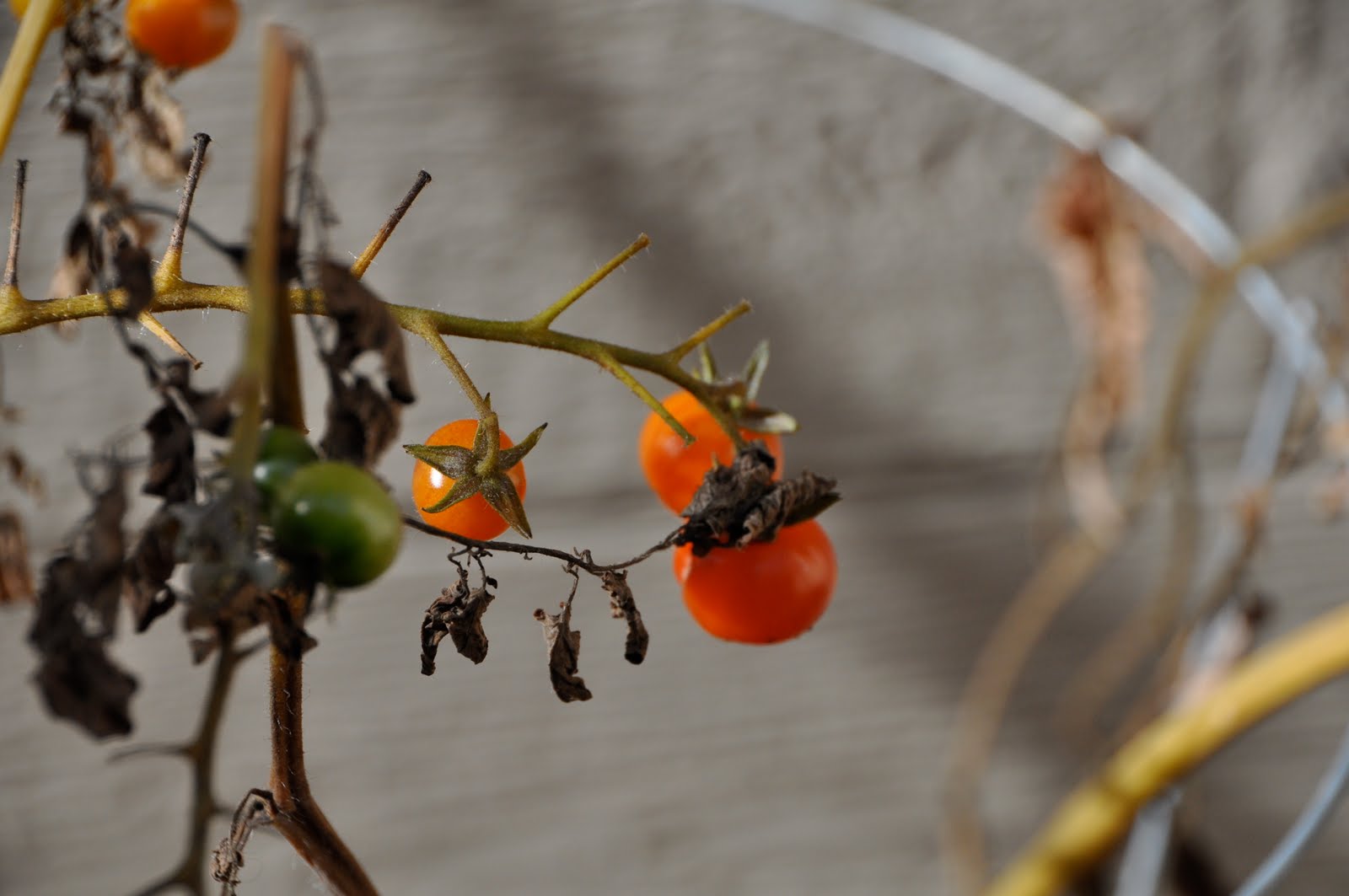
On January 1st I paused and surveyed the effect of the neglect that set in during the Fall. At first glance my yard looked like a graveyard of dried tomato plants with withered leaves and bent stalks. A closer look however revealed a surprise. The unexpected harvest was just a small handful of ugly, tiny tomatoes with exactly the flavor I had hoped for a Winter earlier. True, it wasn't the harvest I expected, but it was there, even after I had given up hope.
Was 2009 less than the year you envisioned as the calendar rolled over from 2008? Were you, like me, able to mine some small solace from an otherwise less than stellar reality? If so, you are not alone. Regardless, Happy New Year to you and all the unexpected yields that are to come.
Subscribe to:
Posts (Atom)